
Willing Teams, Limited Tools
We launched our two-minute sustainability survey in late-2025. Five short questions give valuable insights into what’s going on out there – and as a thank you for participating you get sustainability action suggestions, tailored to your answers, all for free. You don’t even need to log in.
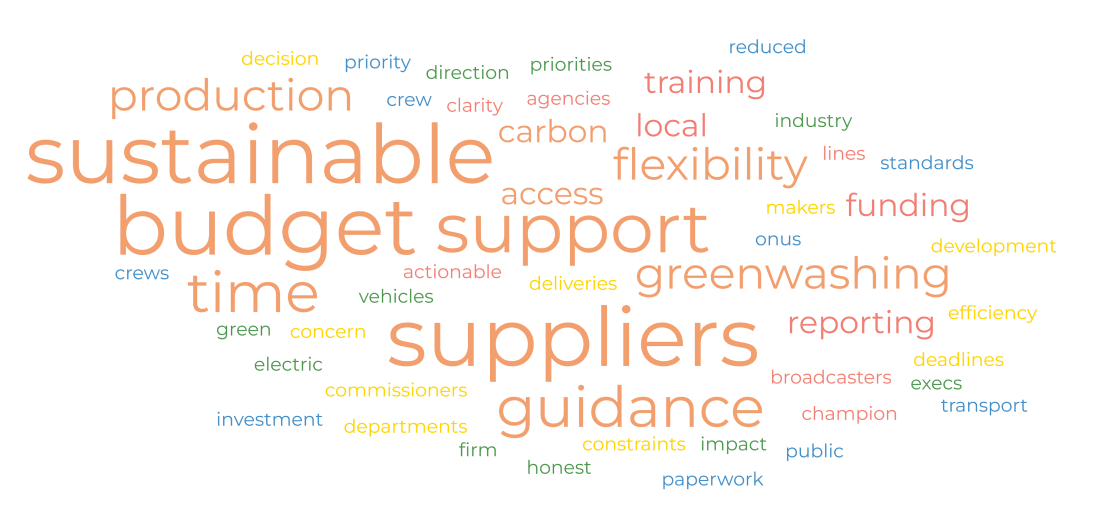
The results are very interesting; you can see the most common keywords in the graphic, but the key insights are:
Overall, crews want to work more sustainably – but many report not yet having the tools or support to deliver it as standard, with sustainability still widely seen as something that may slow production down.
We plan to keep the survey open long-term so we can track trends and attitudes over time. Your participation is hugely appreciated.
Albert
Albert have recently published a new roadmap proposing a pathway towards lower-carbon production technologies for producers, suppliers, policymakers and individuals across the production ecosystem. While their roadmap focuses on the UK, its authors hope it will help inform similar approaches internationally.
By 2030, it calls for productions to:
You can see the Albert report here.
US News
RMI, Disney, Netflix and other members of the Clean Power Initiative also published a roadmap late last year.
This explores how lower-carbon power solutions – including battery systems and alternative fuels – could be rolled out more widely across production, depending on local infrastructure and supply chains.
UK News
Wind and solar overtake fossil fuels in EU power supply
According to a recent annual review, wind accounted for around 30% of electricity generation across the EU in 2023, compared to approximately 29% from fossil fuels.
In the UK, renewable sources now account for over half of electricity generation in some periods of the year, following continued expansion of wind capacity.
Why does this matter to productions? As the electricity grid becomes less carbon-intensive, plugging into mains power, whether directly or via battery systems, can offer lower-emission alternatives to diesel generation. It may also help reduce energy costs, depending on tariff structures and timing of use: for example charging electric vehicles or battery units overnight (off-peak) is often more cost-effective, and may coincide with periods of higher renewable generation on the grid.
Nature loss identified as national security risk
The UK Government’s Department for Environment, Food & Rural Affairs (Defra) has published a report prepared by the Joint Intelligence Committee, highlighting environmental degradation as a growing national security concern.
It identifies accelerating decline across several critical ecosystems including tropical rainforests, boreal forests and coastal mangroves – as a potential driver of future risks such as food insecurity, migration pressures and economic instability.
Why does this matter to productions? Production teams can support more sustainable food systems through practical measures on set. Catering waste, for example, can be diverted to anaerobic digestion facilities where available, or – in some cases – used locally in agricultural applications.
Prevention remains the most effective step. Portion planning, accurate ordering, and correct separation of food waste from packaging can all help reduce avoidable waste during filming. Also offering more plant-based meal options alongside standard catering can help reduce the environmental impact of on-set catering.
Keep calm and keep going
Global emissions growth has slowed in recent years, and some projections suggest emissions could begin to decline before 2035 under current policy pathways.
While this would represent progress, it remains well short of the reductions widely considered necessary to limit warming to 1.5°C, underlining the need for continued action across sectors, including film and TV production.
Quirky Tech Spotlight
Mobile charging robots are now beginning to appear in pilot deployments. These units can be summoned via an app to provide on-site charging for electric vehicles, which, if scaled, could potentially be useful in locations where fixed infrastructure is limited.
Some models are designed to operate on uneven terrain, which may make them suitable for temporary event sites or filming locations.

572
Article last updated on Mar 12th, 2026


